
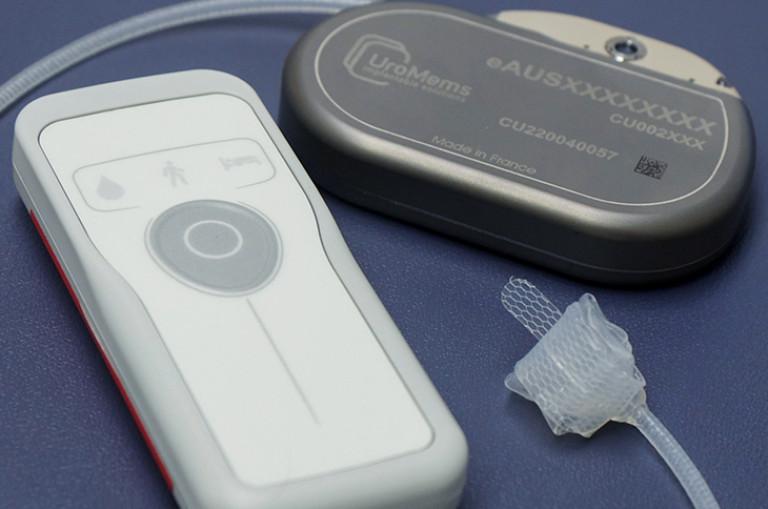
A surgical team at Duke Health has performed the first U.S. implantation of a new remote-controlled artificial urinary sphincter that aims to give men who struggle with incontinence after treatment for pelvic cancers a more personalized and discreet way to manage bladder control.
Millions of men face daily challenges with stress urinary incontinence that diminishes their quality of life, including after surviving prostate and other pelvic cancers.
“After prostate cancer treatment, about 10 to 20 percent of men develop enough incontinence that they have to wear diapers or pads,” said Andrew Peterson, MD, professor in the Department of Urology at Duke University School of Medicine. “Some men become reclusive. They don't go out to dinner, they don't go dancing, they don’t do the things they love because they're anxious about leaking urine.”

The current gold-standard surgical treatment involves a manually operated artificial urinary sphincter that requires a patient to squeeze a pump inside their scrotum to allow the release of urine. This conspicuous process can be uncomfortable to do in more public settings, and the pump can be difficult to reach for men who are older or have limited mobility.
The novel electronic device packs a pump, reservoir, and battery into a small can, similar to a pacemaker, that is implanted in a patient’s abdomen just under the skin. It’s operated by a remote control the size of a car key fob.
When the patient wants to urinate, he pushes a button on the remote which sends a signal to the device to open a cuff around the urethra, allowing urination. The device is set to a cycle which automatically closes the cuff to stop the flow and is adjustable based on the person’s activity.
“We’re now so good at curing most cancers in the pelvis that many men are living long, healthy lives, but one of the most devastating side effects of treatment can be urinary incontinence,” said Peterson. “As a reconstructive urologist and cancer survivorship specialist, my focus is helping men move beyond simply surviving their cancer to reclaiming their dignity.”
Dr. Peterson is co-principal investigator of a clinical trial to determine the safety and effectiveness of the electronic artificial urinary sphincter. The FDA cleared the way for the trial by approving an investigational device exemption in 2025.
“Our trial will follow patients for up to five years because the goal isn’t just effectiveness — it’s safety, durability, and a real improvement in quality of life,” said Peterson.
A prospective study in France followed six men at one year after implantation of the electronic device. The study found it to be safe and effective, reducing urinary leakage by more than 75% in 80% of the men. The study was funded by the manufacturer of the device.
The study plans to enroll up to 140 men at several sites in the U.S. and France.